
Composer Azer Hajiasgarli: "Composers pay 29 percent tax, how fair is this?"
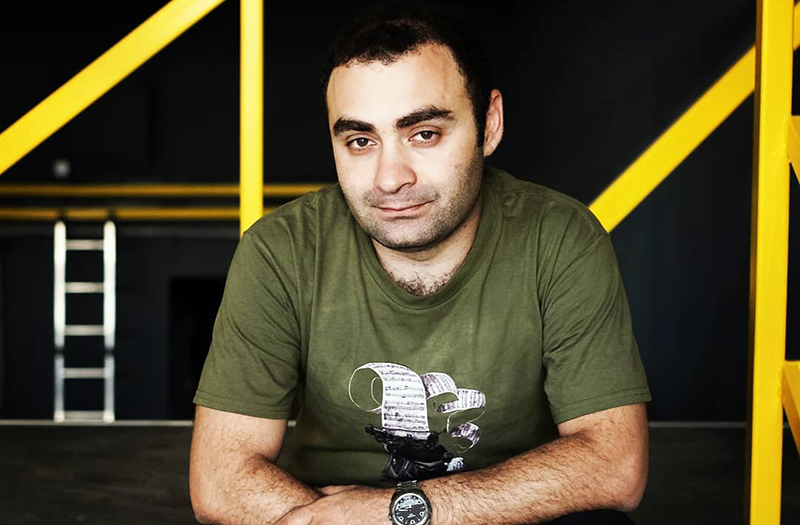
I met Azer Hajiasgarli during our collaboration with the "Shne" theater. He is the author of my first theater work, namely the music for the poems I wrote for the play. Without giving much information about him, I would like to present our interview with him to you.
- Az Er, there are quite a few people in the art community who know you. How would you introduce yourself to those who don't know you?
- You have to love your art, I don't do this work to be recognized. It's just the art I love. I would introduce myself as a serious composer who loves his art. If I continue this work, I am working for the needs of the listener, the demands of modern times, and the development of Azerbaijani music.
- Why are you doing this work and why did you choose composing as your art?
- I have had many chances to pursue other professions. But I did not choose them. Even if it turns out to be rough in this art, my skill is that I chose a field that I love and enjoy, writing music, as my art. Music is something that you have to be completely honest with. If you are honest, it will love you and you will be able to express what you want and what is in your heart through music.
- Do you remember your first composition?
- He will never be forgotten. I wrote a song and tried to sell it. I was very young. Later, I started writing very small plays, preludes. I showed them to many teachers. Ismayil Hajibeyov, Mobil Babayev and other composers. The initial period was very difficult. At first, you think that you are very talented, but as you go deeper, you realize that there are many things you don't know.
- Most artists have artists and teachers who bless them, support them, and approve of their steps. Who have been such people on your artistic path?
- In general, the composition school is a well-established school and has come a long way. My teacher is Aydin Azimov. Aydin Azimov was a student of Gara Garayev. It was Aydin Azimov who first found and orchestrated the national anthem of Azerbaijan. I studied at the composition faculty of the Baku Music Academy in the class of Khayyam Mirzazadeh, and graduated in the class of Jeyhun Allahverdiyev. I completed my master's degree in the class of Aydin Azimov. In 2010-2011, I studied at the sound direction faculty of the St. Petersburg Academy of Cinema and Television (GuKiT.S.P) in Russia. I took lessons from Nazim Mirishli, Agshin Alizadeh and many other teachers. I am glad that our composition school maintains itself with such giants.
- Azer, you mentioned a composition school... Are you satisfied with the Azerbaijani composition school?
- Currently, the Soviet school, that is, conservatism, still persists. For example, in Europe there is a trend towards electronic, digital music, a search for new trends. I can't say to what extent we need this or not, but I think that certain changes are needed. It's not just about the composition school. I think that music education needs to change a bit. The path from in-depth study of our national music to electronic music needs to be updated. Considering the recent impact of computers and programs on music, I think that serious innovations are needed.
- In that case, doesn't half of the responsibility fall on the Composer and the Union?
- No, I don't think that's true. Because the Composers' Union is not an educational institution, and the union is primarily an organization aimed at helping composers. How it works is its own business.
- So, are you satisfied with the activities of the Union?
- Of course, there are certain positive aspects. One of them is to help composers as much as they can. In addition, they try to hold concerts and anniversaries. Maybe they could do more, maybe they could come up with some other ideas, I don't know. But today the Composers' Union can be considered a strong organization. At least because at the moment everyone calls themselves a composer, but becoming a member is not an easy task. You have to have a certain path, a biography, to be worthy of it.
- What does the Composers' Union contribute to Azerbaijani music?
- It depends on its capabilities. I think that if it had more opportunities and more finances, it could have done more. Like organizing big concerts, festivals, and competitions.
- So, many things have their roots in materialism.
- During the Soviet era, works from professional composers were purchased for royalties. It was only after the collapse of this system that the situation changed. Composers of that era began to experience difficulties in the era of the new market economy. Now there is a greater need for composers in the field of song genres, cinema, advertising, and television. A certain period is needed for this. I think that the issue of materiality will be resolved in the future.
- Asef Zeynalli, Schubert, Uzeyir Hajibeyov, Gara Garayev, Jovdat Hajiyev... These brilliant composers wrote their most prominent works by the age of 30. What about Azer Hajiasgarli?
- This question has made me think too. But I'm still searching, trying to put out even more perfect works.
- Azer, why don't you advertise yourself?
- Advertising in our country is so cheap and primitive that I don't want to present myself like that. I thought about it for a while and decided that I just needed to write good music, and that's it. This is advertising in itself.
- You write good music... And what about the result? Since the 2000s, mediocre music has been rampant. Why can't good music emerge? Or maybe our composers can't keep up with the pulse of the new era?!
- I just write music. The factor of exposing it, of someone listening to it is not important to me. Whatever the masses listen to the most is considered a pulse. But there is also such a theory that whatever the masses listen to the most is wrong. When Tarkovsky's "Stalker" was released in America, they told him that many people started flocking to your cinema. And he said, look what a terrible film I made that so many people want to see it. There is music that you like at the moment, but after listening to it two or three times, it tires you. There is music that you start to love more and more the more you listen to it. I just write music. Its result will be known in the future. Most composers have passed this stage.
- What kind of music should Azerbaijan present to the world? For example, musicologists do not like the music that Sevda Alakbarzadeh presented to Europe. They say that it is necessary to present to the West not with Western-oriented music, but with ethnic, national music.
- I don't agree with this idea. Did Beethoven think that the time would come when he would be listened to in Azerbaijan? Did Uzeyir Bey think that anyone in Europe would listen to him? His idea was only in Azerbaijani music. Just like Beethoven wrote for German music. There is no need to show some of our music to the world. We just need to write music thinking about the people. For example, both children and adults can watch "Arshin Mal Alan". This is the power and beauty of music. We need to achieve this. It depends on music to go beyond borders and achieve this. "Arshin Mal Alan" is our only film that has reached the world box office and earned millions.
- Writing by order or by inspiration?
- Writing on demand is more important. Inspiration is a somewhat mythologized feeling. If you're writing music anyway, being honest with it and working hard will create inspiration. But nowadays, orders are very important. Music is already used in synthesized art forms - theater, cinema, and this must definitely be on demand. If you think that writing music is nothing to me, I'll do it effortlessly, and if you write purely for the sake of competition, it will move away from you. Like a woman.
- Does the material aspect of your art satisfy you?
- Actually, I am very happy that I can earn with this art. There is just a huge gap between the pain we suffer and the value given to it. In my main field, film music, the situation is not encouraging when compared to other countries and music fields. As a composer, I am dissatisfied with the tax system. Because I pay 29 percent tax. This is more than the tax paid by those involved in trade. Almost a third of the royalties they receive go to tax. How fair is this? Singers also pay the same tax, but they have wider earnings and opportunities.