
Azer Hajiasgarli: "There is a serious need for music in our national cinema"
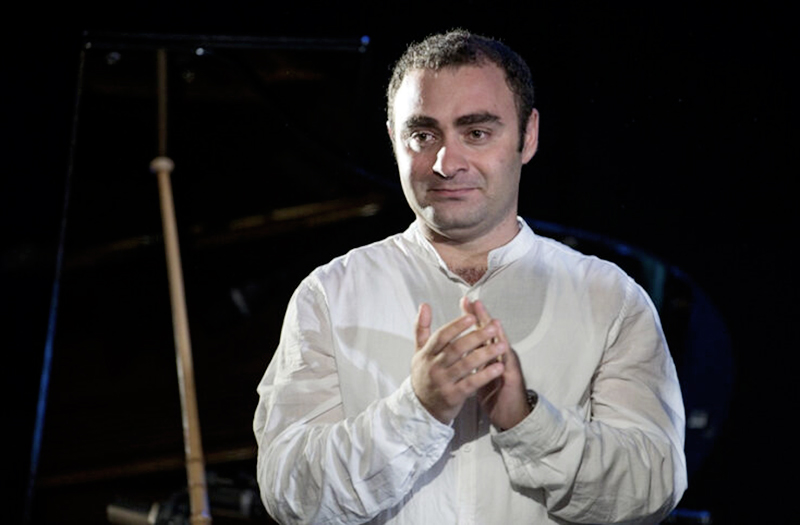
Our interviewee is Azer Hajiasgarli, one of the most prolific creative people of recent times, the composer of many feature films such as “Monologue of a Lonely Man” (dir. Emin Efendiyev), “Titrema” (dir. Amil Amal), “Maryam” (dir. Elchin Musaoglu), as well as documentaries such as “Bashlıbel Gündilyı” (dir. Parviz Hasanov), and “Sen haralısan, durna?” (dir. Ilkin Yusif), the premiere of which we are eagerly awaiting. We talked to Azer bey a little about himself and a little about Azerbaijani cinema and music.
– Azer, you received your first education at Baku Engineering University. Was this at the request of your parents, that is, with the idea of “having a craft in your hands,” or was there another reason?
– No. Actually, I wanted to enter the violin class of the Asaf Zeynalli Music College. But when I submitted my documents the first time, they didn't accept me, so I entered, studied, and graduated from the Faculty of Economic Management of the University of Engineering; I have a bachelor's degree.
– Was your initial education useful in your creative activity?
– It happened. First, my English improved significantly. This opened the door to new technologies for me. That was the era when the Internet and software were developing rapidly, and I began to freely explore and learn them myself. And of course, mathematics… If I’m not mistaken, Pythagoras said that there are four types of mathematics: algebra, geometry, astronomy, and music. Almost all European classical music – choir, church music, etc. – is based on mathematics. That is, you can compose a work with mathematical formulas as a composer, there is no need to sit at the piano.
– I vaguely remember from music classes in high school that tones, quarter notes, and other things were represented by numbers. But I think there's more to it than that, there's a deeper connection.
– Indeed, it is very deep. European music is mainly diatonic, that is, it consists of a natural system - major and minor. In fact, these are Italian modes. There are Greek modes, pentatonic, etc. Azerbaijani mugham itself also consists of systems, Uzeyir Bey opened up the technological aspects of that system and presented it to us, and this is, in the truest sense of the word, mathematics. We mentioned the system aspect. There is also the form aspect. Music also consists of form. In cinematic terms, if the script has a beginning, middle, and end, then in the same way we have an exposition, operation, and reprise of music. In essence, this itself is mathematics and takes on various forms of its own.
– So, you don't consider the time you spent at the University of Engineering to have been wasted.
– On the contrary, what I learned there really helped me a lot. Now I think about what I benefited from. I had some childhood traumas. Later I realized that when you grow up, these traumas work in the opposite way. That is, when you grow up, you want to prove that you are not what they instilled in you as a child. Therefore, you try to be overly productive. We often try to heal our traumas, not realizing that they benefit us.
– You were a student of Khayyam Mirzazadeh. Did he play a role in your involvement in film music?
– I also had preparatory teachers – Elnara Dadashova, Mobil Babayev, Ismayil Hajibeyli. I showed them my works. I started writing music for films when I was studying for a master's degree. During those years, my specialist teacher Aydin Azimov gave me a lot of advice, explained to me the importance and necessity of film music. Because, frankly, I didn't think I would continue this work. At first, I was inclined towards sound. The Ministry of Culture sent me to study at the sound direction faculty of the St. Petersburg Academy of Cinema and Television to improve my skills in this direction. After returning, I started working as a sound director and music composer in films. By the way, many people don't take music composition very seriously.
– Music composition and writing original music for a film – can you explain the difference between the two?
– Music composition has its own characteristics. We have the phonograms ready-made, we just need to place them correctly. But here too, it is important not to deviate from the general pattern, to choose the right music for that image or a certain situation. This work gave me the opportunity to get to know directors, their tastes better, and to form the necessary dynamics in myself. Perhaps that is where I learned film music. It seems to me that the process of experimentation creates a lot of opportunities for a person. I was making certain discoveries, composing new music, and then I asked the directors to listen to my music. So, I slowly started writing music for films. At that time, I continued to work as a sound director for a while, but then I saw that they – that is, the sound and the music – interfere with each other, your idea remains either in the sound or in the music. Each of these is a separate job, a specialty, it is not right to mix the two.
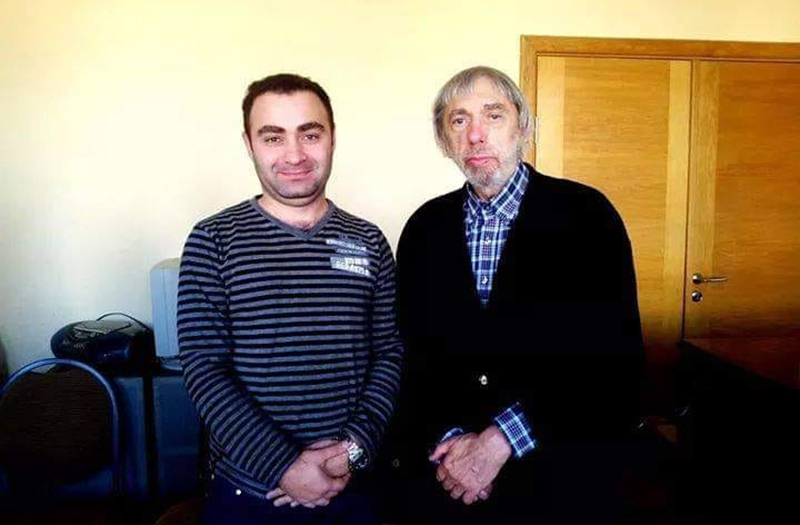
Azer Hajiasgarli and composer Eduard Artemyev
– Film music is a creation with boundaries, there is an author of the film and you have to agree with him on everything, the main thing is how he wants the music. This means that creative freedom is limited. How do you overcome this?
– It is a very difficult point. There are two ways here: either the director is completely dominant, or he lets you go free. Sometimes it happens that you go through several stages before you become a producer. But it seems to me that when you let the composer go free, the work is of higher quality. Some directors consider the film to be completely theirs, and they do not understand that the people working with them are also creative people. His main task is to find like-minded creative people, for example, a composer, an artist. But when the director gives you examples, or directs you… Let's say you are a director and you like jazz or rock, you want such music in your film, but the composer sees the music in that film differently. I have often noticed that after a while, these directors are satisfied with the proposed music. But at the initial stage, there is always a disagreement. For example, the music I wrote for Parviz Hasanov's "Bashlibel Diary" was not liked the first time, but after a week they said that we cannot imagine any other music here. Such situations have happened to me a lot. Therefore, I think that you just need to believe in the composer. I understand the directors, they want to create a high-level work. But sometimes they don't understand that the composer also thinks the same thing. On the other hand, innovation in music is something that is not at first thought. This is a novelty - whether it is a car, a telephone, clothes, etc. - you feel the same thing. But after a while, that novelty that you do not accept turns into a cult. On the other hand, I think that if you like a new piece of music the first time, it means that you have already heard a similar melody at some point, it is in your subconscious. And this leads to a bit of plagiarism in music. Sometimes they do it deliberately. In this regard, the authors most often hinder the composer. You give me an example of Bill Evans, you want a similar melody. I will write what you want, but it will be another variation of Bill Evans, it will not add any new color to the film. Some directors are also against music in general, and I think that is not the right approach.
– Do you not accept films that do not use music or use it very little?
– First, it is strange to avoid music just for the sake of reality, because the film itself is fiction, an illusion, and there can never be any absolute reality. Therefore, music can be used with ease. Second, music has been with cinema from the very beginning, and since the first films were silent, it was accompanied by music, that is, music is a part of cinema. The third issue is deeper. When we look at Indian, Iranian, Turkish, or Italian, Japanese cinema, we can understand which type of art is more developed in those countries. In Indians, it is music and costumes, while Japanese films are more based on legends, epics, simple and traditional models. In Azerbaijan, the strongest type of art is poetry and music. By refusing music, you are reducing the most important factor.
– In what sense? As a factor of communication with the audience?
– No. What should we do to show that we are Azerbaijanis? What will you be proud of when foreigners come here, or when you go there? This factor is very important. Our facial structure is not such that we stand out from others. Clothes – everyone is black and white, cars – black and white, everything is black and white. Dress me in red, blue, or any other color, and I will no longer be Azerbaijani. But add a tar to it and it will already be known that this is Azerbaijani cinema. Even authors who say “I don’t want to use music” find a source of music somewhere - on the radio, in the car. In fact, they also know that the music factor is important. I even consider the development of the musical comedy genre, musicals, to be a more correct direction for Azerbaijani cinema. There are such experiences - “The Umbrellas of Cherbourg”, “La La Land”, “The Sounds of Music”… In other words, it is possible to make very good films. I think this would be a very good strategy and we could go further with it. But the directors are a little hesitant about it.
-So, you suggest that we continue with the concept of “poet-people”?
- Not in a banal way, of course. But there must be some root. I take “Arshin mal alan” as a model, because it has proven itself in cinema. As I said, one of our main values is music and poetry. For example, mugham seems like too much folklore to us, but for a foreigner it can turn into a fantastic sound, mugham can be used in films in a more fantastic way, we can do very interesting innovations with mugham. If we are lucky, then maybe we will even get an “Oscar” for music. Because whether we like it or not, music is a very ancient art for Azerbaijan, the mugham system, you could say, has come a thousand years. And our poetry is also very ancient. I don’t know how to do this, maybe some state institution can deal with this, but there must be a different element that creates the understanding of “look, this is an Azerbaijani film”. Only after that can we think about art-house. There are so many art-house works in music that perhaps there aren't as many in cinema. For example, there is a work by John Cage called "4.33". A man comes and stands at the piano for 4 minutes and 33 seconds, then leaves and doesn't play anything. Many new directions and solutions have been found in film music. Now electronic music has also come into play and you can experiment as you wish. I want to see myself not only as a composer who writes music for a film, but as a composer who experiments. I don't want to just fill the film, do what the director or the audience wants. That may be bought, maybe that film will be watched, but for a work to become a cult, you definitely have to do something new there. There has to be something new so that it stands out in comparison and is appreciated.
– You say that national music plays an important role in showing the Azerbaijani identity. So how should this be done so that it does not create a cliché impression?
– I understand you. There is a way out of it. Take, for example, Schnittke, Morricone, or modern American composers. Take the music of “Dune”, the music of the film “Schindler’s List”. Both are in major and minor, that is, in diatonic scale. Azerbaijani music has seven scales. The structure of ashug airs, the scale system is also different. It is possible to create a fairly new style on it. You can work with the field and the instrument in such small details that when you listen to it, you will say that this is the music of an art-house film. We simply use the clichés you mentioned more as a form. However, if we take the technical capabilities of the instrument itself, a lot can be done: mixing it with electronics, or writing a piece together with some instrument of a symphony orchestra… it is possible to make very interesting combinations. I want to say one more thing. I often hear that our music is dead, or rather, that now there are no composers and good music in Azerbaijan like in the past. I think this is a wrong idea. The works created now will receive the value they deserve in twenty or thirty years.
– I think that the idea that “now there is no music, no composers like in the past” is a populist idea. They say the same thing about our cinema. That “previous” music, composers were promoted during the Soviet era, and they are still promoted now. Almost every TV channel has a program about how retro music was created, but there are no programs about new music, new composers.
– I think that we are now living in the 1990s in art. That is, what was in art thirty years ago, is now in our memory. If you ask any person on the street right now what films about the war were made in Azerbaijan, they will immediately say “Faryad”. That era is also reaching us in music now. Therefore, a certain period must pass for our music and work to be recognized. I do not see this as a problem of specific individuals or any institution. That is, the issue is not lack of support, lack of promotion. This is simply the law of art, it has been like this in all periods. I.S. Bach’s notes were found after seventy years. "Carmen" was first whistled, and Georges Bizet fell into depression because of it. Fifty years later, it turned out that "Carmen" was, you know, a masterpiece. Now we are still experiencing the emptiness of the 1990s. Unfortunately, that's how it is. Otherwise, we still have good composers who are working productively.
– Azer, what are your principles of working with directors and do you have any criteria when choosing a project?
– To answer these questions, I will start a little from afar. After the 1990s, it seemed that there was a strange attitude towards composers, or rather, towards original music in cinema. Directors used more ready-made music on Internet platforms, mainly music from foreign films, and were looking for albums. Then YouTube was created. YouTube initially began to cause great harm to composers. At that time, there were interesting composers like Elmir Mirzoyev, Rufat Khalilov, and Vugar Jamalzade, but they did not cooperate with them. Because YouTube offered an easier way. All the world's music had become so accessible that there was no need for a composer or original music. But then YouTube and festivals did not allow the use of music whose copyright had not been purchased. Well, then they started to turn to composers again. Unfortunately, there was a huge gap. For example, there was no longer a studio in the country to record with an orchestra, and there still is none. We definitely have to go abroad for such recordings. Imagine how much money must be spent on writing music for a large orchestra. The quality of music played by a live orchestra is different from the quality of electronic instruments.
However, in Soviet times, the film studio had such a studio. On the other hand, now the cooperation between directors and composers is also extremely problematic. True, there are directors who are interested in and aware of both classical and modern music. There are also those who prefer only one style of music. A professional composer studies and researches the entire history of world music in any case. A composer also has the function of researching the listener. That is, I study how the listener listens to music, his taste, etc. Because every composer has his own style, he tries to develop it, to add innovation to his work. For example, I wrote an hour and a half ballet to Jafar Jabbarli's "Pale Flowers". The whole work is in a heavy minor tempo from beginning to end. There is only one cheerful piece of music throughout the whole work, and that is at the very end: Bahram kills Pari and starts dancing from the weight of the tragedy he experienced. This is my point of view. I understand that no one wants bad music to play in their film. On the other hand, the music that the director likes and wants is not considered perfect just because he wants it. Therefore, there should be such a creative relationship between us that everyone can explain their opinion. Many directors understand this, many do not interfere in the composer's work. Some do not like the music the first time they hear it, and then change their opinion. I do not want my music to be called "great" as soon as it is played. If it is liked immediately, then an association has been formed with some melody that you heard before. In fact, this is not good. Even a director should check and listen to the music offered to him several times; listen to it not for one day, but for two or three days in a row to feel it. Of course, primitive works also happen. There is primitive music, there is simple music, there is complex music. When it is primitive, of course, it will get lost. Directors also avoid this. It is just that sometimes simplicity or complexity can confuse them.
-So how do you choose projects?
– Honestly, I am often criticized for taking on too much work, that you should already choose, find a better project, a more suitable one. In fact, I have already started thinking about it, but I didn’t choose before. You know, for me work is not just creativity, but also a process of improvement. One job leads me to the improvement of another. I have gained more experience by working, than by sitting and doing some searches.
– Then let me put the question this way. Obviously, the majority includes commercial films, TV series, etc. Then there are projects like “The Monologue of a Lonely Man” and “The Diary of a Headless Horseman.” So, what do you pay attention to in more serious, global potential projects?
– I approach such projects more creatively. They are more complex. There are also works where I am most dissatisfied with the directors' intervention. Because they are more creative work, I try to do something new more often, and that novelty sometimes irritates the authors. In such works, we experience more conflict with the authors. At the same time, it is more interesting to work on such projects.
– Do you argue about the music?
– There are even directors I haven’t spoken to yet. There’s Elchin Elkhanli, the director of the film “13” about Khojaly. We haven’t spoken since that film. About a year and a half has passed. We worked on the film, but we didn’t understand each other at that time. However, we were friends from a very young age, we worked together. Our first collaboration with any director is usually difficult. We need to work at least four or five times to make the process easier. For example, Tahir Tahirovich. I already know what he wants and doesn’t want, so I’m comfortable working with him. Usually, I start by reading the script. First, I try to determine what it resembles, where it is influenced by – what kind of film does it remind me of? I do this to understand the director’s taste and approach. Then, based on this, I look for a new way. Of course, there may be a script that I can’t compare to anything. In such cases, we talk more with the author. But it's more convenient to start working by watching the film, you feel the director's tempo and rhythm more clearly. This is very important. Because I've tried to write a script myself. After working with the script, the rhythm of the music and the rhythm of the film may not coincide, may not be suitable. Therefore, I should at least watch the draft version of the film to understand the director's pace, what rhythm he works in. I repeat, some directors want less music, some don't want it at all. Some try to give more music, which is a very controversial issue. Although for some reason, recently everyone is trying to use less music.
– And you don't like it.
– When I say no, I still try to do my job well. But it seems to me that music is an integral part of cinema. Maybe, from a dramaturgical point of view, there really is no need for music. Still, it seems to me that music is necessary.
– So, you want to hear and see the fruits of your time and effort on the screen.
– There is that too. And as I said, Azerbaijani cinema needs music.
– Azer, what do you think, should film music and composition be taught as a separate subject, or is there no need for it?
– This is still a controversial issue, writing film music is still not taken very seriously by academic composers. I think that cinema has developed too much and, given the abundance of genres and styles, it is necessary. Academic composers sometimes do not take cinema, even the song genre, very seriously. For example, currently the song genre is not in the hands of professional composers. However, a composer who boasts of his professionalism and academic education should be able to do this too. I also have an academic education and write film music.
– You yourself said that you graduated from academic composition, but you participated in trainings in film music, learning by doing. So, this is a slightly different direction.
– I think that if someone wants to improve themselves in this direction, they can. Special education can also speed up this process and lead to better development. By the way, I teach such a subject at the Baku Academy of Music – audiovisual composition. But it needs to be improved a little.
– I'm done with my questions. Thank you for your time.
Interview prepared by: Aygün Aslanlı